
Septic problems announce themselves in ways that are hard to ignore — a wet, bright-green stripe across the yard in August, a smell near the tank after rain, drains that back up when the washer runs. And if you are building on rural ground here, septic system installation is often the item that determines whether you can build at all, because the soil has to pass before anything else proceeds. Buckeye Land Clearing & Excavation installs and repairs household sewage treatment systems across Southeastern Ohio, on the difficult clay and shale hill ground around Chesterhill, McConnelsville, Beverly, Athens, Nelsonville and Glouster. We handle the excavation and installation side and work with your county health district through the permitting process.
What Septic System Installation Actually Involves
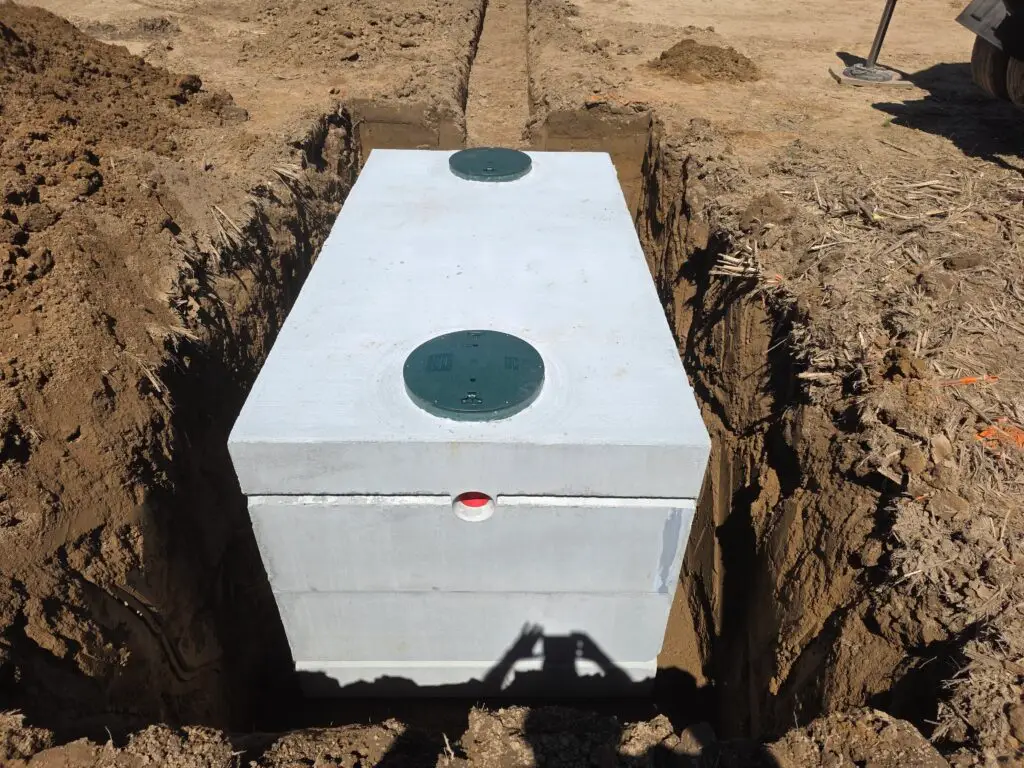
Most people meet the septic process at the worst possible moment — a failed system, or a building plan on hold. A household sewage treatment system takes wastewater from the house, separates solids in a tank, and disperses the liquid into soil that treats it biologically before it reaches groundwater. In Ohio the process is heavily regulated for good reason, and it starts long before a machine shows up. First is a soil evaluation: a certified soil scientist or registered sanitarian digs and reads the soil profile, identifying texture, structure, restrictive layers and the seasonal high water table. That evaluation determines what system your property can accept — a conventional tank and gravity drain field where soils allow, or a mound, drip distribution or aerobic treatment unit where they do not. Then a design is prepared and submitted to the county health district for an installation permit, with setback distances from wells, property lines, structures and surface water all governed by rule. Only then does installation begin: excavating the tank pit and setting the tank level on bedding, running the building sewer at proper fall, excavating and constructing the soil absorption system to exact elevation, installing distribution piping, aggregate or chambers, backfilling carefully so the trench bottoms are never smeared or compacted, and grading the finished surface to shed water away from the field. The health district inspects before backfill. What you end up with is a permitted, inspected system with a documented design — the thing a buyer’s lender will ask for later.
Our Septic Process
Step 1 — We Look at the Site and the Existing System
On a failing system we start by determining what is actually wrong, because “the septic is bad” covers several very different repairs. A clogged line, a failed pump, a collapsed baffle, a saturated drain field and a system that was undersized from the start each have different fixes at very different prices. On new construction we look at the proposed house location, the well location, the slope, and where a field could physically go before you are committed to a footprint.
Step 2 — The Soil Evaluation
Soil is what treats the effluent, so soil determines the system — and this step is handled by a certified soil scientist or registered sanitarian. You hire the evaluator directly, and we’re glad to hand you a list of providers registered in your county. They open the profile and identify the seasonal high water table and any restrictive layers. On this terrain that result regularly changes the plan: clay-heavy subsoils and shallow bedrock are common here, and a site that won’t accept a conventional gravity field may still work with a mound or drip system. Better to find that out before the foundation is poured than after.
Step 3 — We Work Through Permitting With the County
Ohio’s sewage treatment system rules are set by the Ohio Department of Health under Ohio Administrative Code 3701-29, but permitting, inspection and enforcement are handled by your local health district — and districts may adopt stricter standards than the state. A design based on the soil evaluation goes to the county for an installation permit before work begins. We coordinate that process rather than handing you a stack of forms.
Step 4 — We Install to the Approved Design
Installation follows the permitted design exactly, because deviating from it fails inspection. The tank is set level on proper bedding, the building sewer runs at consistent fall, and the absorption field is excavated to precise elevation — a drain field is a level structure, and being off by inches across a trench run puts effluent in one end of the field instead of distributing it. We work trenches when soil is dry enough to avoid smearing the sidewalls, which is what seals a field’s ability to accept water. The health district inspects before anything is covered.
Step 5 — We Backfill, Restore and Hand You the Documentation
After inspection we backfill carefully without compacting the field, grade the surface to shed surface water away from the absorption area, and seed and stabilize the disturbed ground. You get the permit, the design and the inspection records, plus a straight explanation of what will keep the system alive: pump the tank every three to five years, keep vehicles and livestock off the field, keep roof and surface drainage away from it. What you have then is a working, permitted system and a property that will pass a point-of-sale inspection.
Septic Work on Southeastern Ohio Soils
This region is difficult septic country and it helps to know why. Because the glaciers never reached here, the soils are residual materials weathered from sandstone, shale and claystone rather than deep, sorted glacial deposits — which in practice means clay-rich subsoils that perc slowly, shallow and unpredictable depth to bedrock, sloping sites, and seasonal perched water tables sitting on top of a restrictive layer. A great many properties around Morgan, Athens, Washington, Noble and Perry counties cannot support a conventional gravity drain field, and get designed as mound, drip or aerobic systems instead. That is not a contractor upselling you; it is what the soil evaluation says.
It is also worth knowing that help exists. Failing household sewage systems are a recognized water-quality problem in this part of the state, and the Ohio Department of Health and Ohio EPA have partnered with local health districts on repair and replacement assistance — Athens City-County Health Department runs such a program for income-qualifying households with failing systems, and other districts have had similar funding. If your system has failed and the cost is the obstacle, ask your county health district what is available before you assume you cannot afford the fix. We serve Morgan, Athens, Washington, Noble, Perry, Muskingum, Guernsey and Fairfield counties. See our full range of services.
Why Choose Buckeye for Septic Work
Septic installation is excavation work with a permit attached, and the excavation is where most systems are made or ruined. Setting a tank out of level, smearing trench sidewalls in wet clay, over-compacting the field, or building a field that is not truly level will all produce a system that passes a visual glance and fails within a few years. Thirty-plus years of construction and heavy equipment experience is what stands behind getting that part right. More about our background.
Because we also do excavation and land clearing, we can handle everything a rural septic job tends to drag along with it: clearing access to the field location, cutting a drive so a pump truck can reach the tank later, and fixing the surface drainage that is often what killed the old field in the first place. A saturated drain field is frequently a drainage problem wearing a septic costume.
We are also straight with you about the regulatory reality. Ohio requires septic installers to be registered with each local health district where they work, and systems have to be permitted, inspected and documented. That is a protection for you — an unpermitted system is a problem that surfaces at sale, at refinance, and at the health department.
Septic System Questions We Get Asked
How much does a new septic system cost in Ohio?
Cost depends almost entirely on what the soil will accept. A conventional tank and gravity drain field on good soil is the least expensive option; mound systems, drip distribution and aerobic treatment units cost substantially more because they involve more material, more components and more engineering. Soil evaluation, design and permit fees are separate from installation. You cannot get a meaningful number until the soil evaluation is done.
How do I know if my septic system is failing?
Common signs are slow or backing-up drains, sewage odor near the tank or field, standing water or unusually lush green growth over the absorption area, and gurgling plumbing. A system can also be failing without visible symptoms — one that discharges to bedrock, tile, groundwater or surface water is considered failing under Ohio’s rules even if the toilets flush fine. If you are near a stream and unsure, a health district inspection settles it.
Do I need a permit to replace a septic system?
Yes. Under Ohio Administrative Code 3701-29, no one may install a new or replacement system or alter an existing one without a permit from the local health district, and the installer must be registered with that district. Installation permits are typically valid for one year. Replacements normally require a current soil evaluation as well, since the original system’s design assumptions may no longer be acceptable under today’s rules.
How often should a septic tank be pumped?
Every three to five years for a typical household is the standard guidance, though the right interval depends on tank size, household size and usage. Pumping is the cheapest maintenance in the entire system, and skipping it is the most common way people destroy a drain field — solids carry over into the field, plug the soil interface, and turn a $400 service call into a five-figure replacement.
What if my soil will not perc?
It is common here and it is usually not the end of the project. Where a conventional gravity field will not work, alternatives include mound systems that build an elevated absorption area above the restrictive layer, drip distribution that doses effluent slowly across a larger area, and aerobic treatment units that treat effluent to a higher standard before dispersal. These cost more and carry stricter operation and maintenance permit requirements, including regular inspection.
Can I put a driveway or building over a drain field?
No. Vehicle traffic compacts the soil and crushes distribution piping, and structures block the evaporation and oxygen exchange the field depends on. Keep vehicles, livestock, buildings, pools and heavy landscaping off the absorption area and its designated replacement area — Ohio siting rules generally require a reserve area to be preserved, and building on it can leave you with nowhere to put a replacement system.
Talk to Us About Your Septic Project
Whether you are building and need a system designed and installed, or you have one that has quit, call us and we will walk you through what happens next and what it is likely to involve. Call or text 740-557-5998, or describe the situation here. Monday through Saturday, 8am to 5pm.