The barn has been leaning for six years and now it is a liability. The old farmhouse on the back forty is past saving. There is a mobile home on the property you just bought and it is standing between you and a building permit. Buckeye Land Clearing & Excavation works as a demolition contractor across Southeastern Ohio, taking down barns, outbuildings, mobile homes, foundations and small structures on rural properties from McConnelsville and Chesterhill out to Beverly, Athens, Nelsonville, Caldwell and Marietta. We do not just knock things over — we take the structure down in a controlled sequence, get the debris off your property, pull the foundation, and leave graded ground you can actually use.
What Structure Demolition Actually Involves
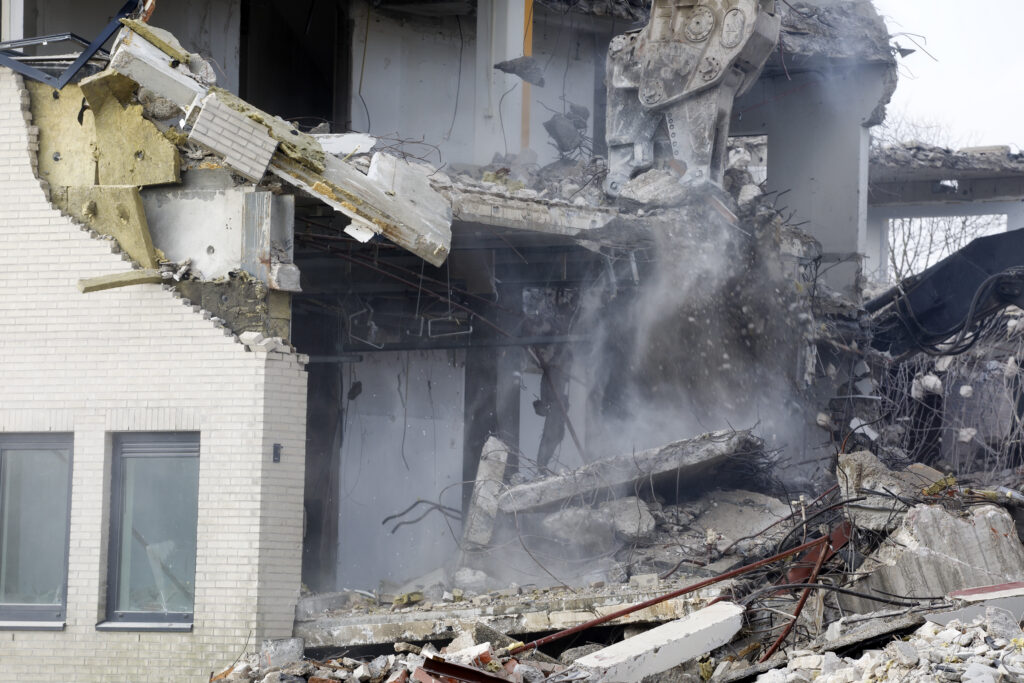
An abandoned structure is not just an eyesore. It is a tax line, an insurance question, a place for groundhogs and copperheads, and on many properties the thing blocking a sale or a build. Demolition is the controlled dismantling and removal of a structure and its foundation, followed by restoration of the site. The work runs in a fixed order. It starts with a survey: age of the structure, construction materials, whether utilities are still live, and whether there is anything inside that has to come out first. Utilities get disconnected and capped at the source — electric, water, gas, and any septic connection — because taking a building down over a live service is how a demolition becomes a very different kind of incident. Regulated materials come next; older structures can hold asbestos in siding, roofing, pipe wrap and flooring, and Ohio has notification rules that attach to demolition itself, not just to abatement. Then the structure comes down, usually with a tracked excavator working with a grapple or thumb, pulling the building in on itself in sections and sorting material as it falls rather than making one pile of everything. Metal, wood, masonry and general debris get separated where it makes economic sense, because separated material is cheaper to dispose of than mixed. Foundations, slabs and footers get broken out and removed. Then the hole gets backfilled in compacted lifts, graded to shed water, and dressed. The finished product is a level, drained, buildable piece of ground — not a scar with a rubble pile beside it.
Our Demolition Process
Step 1 — We Survey the Structure and Scope the Hazards
We walk the building and look at what it is made of and when it was built. Age matters: structures built before the early 1980s are more likely to contain asbestos in siding, roofing, insulation and floor tile, and lead paint is common in the same era. We identify whether an asbestos survey is needed, whether anything has to be abated before demolition, and what the debris is going to consist of, because material type drives disposal cost more than square footage does.
Step 2 — We Handle Notifications, Permits and Utility Disconnects
Ohio EPA’s asbestos program requires a demolition notification for most non-residential structures — barns, commercial buildings and outbuildings — submitted at least ten working days before work begins, even when no asbestos is present; private single-family homes are generally exempt. Ohio EPA publishes the notification requirements. We also confirm local permit requirements and get every utility disconnected and capped at the source before a machine touches the building.
Step 3 — We Take the Structure Down in Controlled Sections
A tracked excavator with a grapple or thumb pulls the structure down in planned sections, working from a stable position with a clear escape path and dropping material inside the footprint rather than outward toward whatever you want to keep. On barns that means understanding how the frame carries load, so it comes down where it is supposed to. Material gets sorted as it falls — metal roofing to one pile, dimensional lumber to another, masonry to a third — which cuts disposal cost and salvages anything worth keeping.
Step 4 — We Remove Debris and Pull the Foundation
Debris is loaded and hauled to appropriate disposal, with recyclable metal separated out. Then we deal with what is below grade, which is the part people forget to ask about: slabs, footers, block walls, old cisterns, hand-dug wells and buried tanks. Leaving a foundation in the ground leaves you with a site you cannot build on and a hole that will settle for years. It comes out.
Step 5 — We Backfill, Grade and Restore the Site
The excavation gets backfilled in compacted lifts with suitable material rather than dumped full and left to settle, graded to shed water away from the area, and topsoiled and seeded so it stabilizes before the next hard rain. When we pull off, there is no way to tell from thirty feet that a building was ever there — just clean, level, drained ground that is finally an asset instead of a problem.
Demolition Across Southeastern Ohio
Rural Southeastern Ohio has a specific inventory of things that need to come down: century bank barns that finally lost a roof, tenant houses that emptied out decades ago, corn cribs, milk houses, garages, mobile homes on land that is now worth more without them, and outbuildings left over from the coal and gas eras. We take them down throughout Morgan, Athens, Washington, Noble, Perry, Muskingum, Guernsey and Fairfield counties — McConnelsville, Malta, Chesterhill, Glouster, Trimble, Nelsonville, Athens, Beverly, Marietta, Belpre, Caldwell, Crooksville, New Lexington, Somerset and Zanesville among them.
Access is usually the variable that decides how a rural demolition job runs here. Structures on this terrain tend to sit at the end of a long gravel lane, on a bench cut into a hillside, or tight against a slope with room to work on only two sides — and every load of debris has to come back out the same way it went in. Steep, narrow township roads off 555, 377, 78 and 676 mean equipment size and haul routing get planned before the quote, not discovered on the first morning. See the rest of what we handle if the structure is only part of the project.
Why Property Owners Choose Buckeye for Demolition
Buckeye is owner-operated with more than 30 years of construction experience behind it, and on demolition that experience shows up as sequencing. Knowing how a structure was built is what tells you how to take it apart safely — which is a different skill from owning a big machine. More about our background.
We also finish the job. A lot of demolition quotes end when the building is down, and the property owner discovers afterward that the foundation, the debris and the grading are separate conversations at separate prices. Our quotes cover the structure, the below-grade work, disposal and site restoration, and we state clearly what is and is not included. Where demolition is part of a larger project, we handle the excavation and site prep and any land clearing around the structure in the same mobilization.
And we take the regulated-material side seriously. Asbestos rules exist for real reasons, notification requirements apply to demolition whether or not asbestos turns out to be present, and a contractor who waves that off is creating a liability that follows the property owner, not just the contractor.
Demolition Questions We Get Asked
How much does it cost to demolish a barn or outbuilding?
Cost is driven by size, construction type, access, foundation, and above all disposal. A pole barn with a metal roof on good access is a fundamentally different job than a stone-foundation bank barn at the end of a quarter-mile lane. Disposal tipping fees and haul distance are frequently the largest single line item. Salvageable material — barn timber, metal roofing, cut stone — can offset part of the cost. We quote per structure after seeing it.
Do I need a permit to demolish a building in Ohio?
Usually there are two separate tracks. Local permits are handled by your county or township building department and vary by jurisdiction. Separately, Ohio EPA requires a demolition notification at least ten working days in advance for most non-residential structures, regardless of whether asbestos is present; private single-family residences are generally exempt from that requirement. We identify what applies to your structure and handle the filings.
What about asbestos in an old barn or farmhouse?
Structures built before roughly 1980 may contain asbestos in siding, roofing, pipe wrap, insulation and floor tile. Regulated asbestos-containing material has to be removed by a licensed abatement contractor before demolition, and Ohio EPA notification thresholds apply. If we see materials of concern, we tell you and get a survey done rather than guessing — disturbing asbestos during a demolition creates a health hazard and a legal problem that is far more expensive than the survey.
Do you remove the foundation and the debris too?
Yes, and we would encourage you to insist on that from any contractor. Full demolition should include breaking out and removing slabs, footers and block walls, hauling debris to proper disposal, backfilling the excavation in compacted lifts, and grading the site. Leaving a foundation in the ground leaves you with something that will settle unevenly for years and a site nobody can build on.
Can you take down a mobile home?
Yes. Mobile and manufactured homes are common demolition work on rural properties here. They involve their own considerations — utility disconnects, tank and pier removal, frame and axle disposal, and separating metal from general debris — and older units can contain regulated materials. Removal typically includes the skirting, piers, steps, porches and any attached additions.
How long does a demolition job take?
The demolition itself is often the shortest part. A typical outbuilding or small structure can come down in a day or two, but the timeline is usually governed by the required ten-working-day notification window, any abatement that has to happen first, utility disconnect scheduling, and hauling. Plan on two to four weeks from first call to finished, graded ground on a straightforward structure, and longer if abatement is required.
Get a Free Demolition Quote
Send a few photos or let us come look. We will tell you what it will take to get it down, get it gone, and get the ground back. Call or text 740-557-5998, or tell us about the structure. Monday through Saturday, 8am to 5pm.