There is a specific kind of frustration that comes with owning brush. You brush-hog it, and eighteen months later it is back, thicker than before, because a rotary mower gives multiflora rose a haircut instead of killing it. Forestry mulching solves that differently: a single machine grinds standing brush, briars and small trees down through the root crown and leaves the material on the ground as a mulch layer. No burn piles, no hauling, no debris field to clean up afterward. Buckeye Land Clearing & Excavation runs forestry mulching across Southeastern Ohio — the pastures around McConnelsville, the fence rows outside Beverly, the hunting ground on both sides of the Wayne National Forest. One machine, one pass, one bill.
What Forestry Mulching Actually Involves
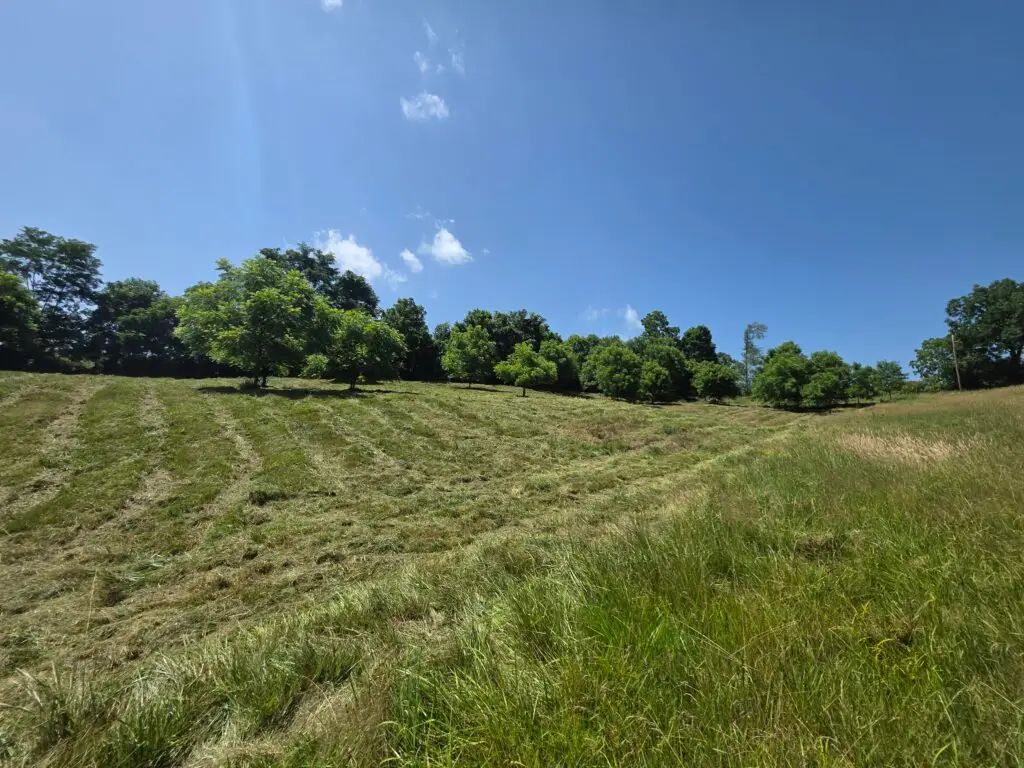
Before: a field edge you cannot walk, a food plot swallowed by honeysuckle, a trail that closed itself. Forestry mulching is a single-machine clearing method in which a rotating drum or disc mulching head, mounted on a tracked carrier, shreds standing vegetation in place and deposits it as chips across the ground. The head runs steel or carbide teeth against a cutting bar at high rotational speed and processes material top-down: it takes the canopy of a shrub first, then works the stem, then grinds the root crown at or slightly below grade. That last part is the whole point — grinding the crown is what kills a resprouting invasive, where cutting above it just prunes the plant. The operator works in overlapping passes, keeping the head loaded but not buried, backing off when the carrier starts pushing soil rather than grinding wood. Capacity is a real limit, not a marketing number: mulching handles brush, briars, saplings and trees generally up to six to eight inches at the stem efficiently, and beyond that diameter the work slows down enough that felling and processing becomes the cheaper route. During the job you will hear one machine rather than a crew, and see chips building up behind it. Afterward you have open ground under a two- to four-inch mulch blanket that holds soil on a slope, suppresses the seed bank through the first season, and breaks down into organic matter instead of going into a burn pile.
Our Forestry Mulching Process
Step 1 — We Look at What Is Actually Growing
Species and stem diameter drive mulching production more than acreage does, so the estimate starts with identifying what is on the ground. Autumn olive, multiflora rose and bush honeysuckle mulch fast. Black locust, thorn and mature hardwood do not. We walk it, take stem-size samples across the parcel, and quote from what is there rather than from an average per-acre rate that will not hold.
Step 2 — We Set Limits and Protect What Stays
Mulching is fast and largely irreversible, so the boundaries get flagged before the head turns. We mark property lines, mast trees, den trees, spring heads, tile outlets, fence lines, and anything else you want standing. On wildlife and hunting properties this step is the job — the value is in the edge habitat and shooting lanes you end up with, not in how much ground got flattened.
Step 3 — We Mulch in Planned Passes
The machine works a planned pattern rather than wandering, which keeps chip depth even and keeps the carrier off ground it has already loosened. On slopes the operator works across the hill rather than up and down it, to avoid channeling water down a fresh track. Chip depth gets managed as we go: too thin and you get regrowth, too thick and you smother the grass you are trying to bring back.
Step 4 — We Take a Second Pass Where It Matters
Heavy infestations rarely finish clean in one pass. Where root crowns are dense, we come back over the same ground to grind below grade rather than leaving a stub that will resprout by June. Where the goal is habitat rather than pasture, we deliberately leave a rougher, more varied finish, because uniform ground is poor cover.
Step 5 — We Walk It With You and Talk About Year Two
We finish the job by walking the mulched ground with you and being straight about what comes next. Heavy invasive infestations usually need follow-up — a spot treatment, a maintenance mow, or a second mulching pass in a couple of seasons — and anyone who tells you one pass ends the problem forever is selling. What you have at that point is ground you can see across, walk, seed, graze or hunt, without a single brush pile to burn.
Mulching Southeastern Ohio’s Reclaimed and Overgrown Ground
Southeastern Ohio has an invasive brush problem with a documented origin, and it is worth understanding before you spend money fighting it. Autumn olive and multiflora rose were deliberately planted here for decades — as living fence, erosion control, wildlife food and mine-land reclamation cover. They took. Ohio State University Extension runs herbicide and control trials at its Eastern Agricultural Research Station in Caldwell, a roughly 2,000-acre property in Noble County where more than 1,300 acres is former or active coal-mining ground originally reclaimed with those exact species. If OSU is running multi-year research on it 30 miles from Chesterhill, the brush in your back field is not a maintenance oversight — it is a regional condition.
We mulch throughout Morgan, Athens, Washington, Noble, Perry, Muskingum, Guernsey and Fairfield counties: McConnelsville, Malta and Chesterhill along 555 and 377; Glouster, Trimble, Nelsonville and Athens down 78 and 13; Beverly, Bartlett and Marietta out 676 and 60; Caldwell, New Lexington, Crooksville, Somerset and Zanesville to the north. Much of it is exactly the ground mulching was built for — sidehill pasture too steep to mow safely, reclaimed strip ground, utility and pipeline easements gone to brush, and hunting parcels near the Wayne National Forest and Burr Oak State Park where the owner wants openings without a landscape full of burn piles. See our other land services if the project turns out to need more than mulching.
Why Property Owners Here Choose Buckeye for Mulching
Buckeye is owner-operated by Stuart Smith, who has spent 30-plus years in construction and heavy equipment. On a mulching job that is not a marketing point, it is a production point: mulching quality lives entirely in the operator’s judgment about head speed, feed rate, pass overlap and when to stop. An operator who is also the owner has a reason to grind the crown properly instead of running fast and billing the acre. More about who you are hiring.
We also scope honestly against the alternatives. Mulching is not always the right answer. If you are clearing to build, you need stumps out and grade established, which is excavation and site prep work, not mulching. If you have mature timber over eight inches through the parcel, you may need full land clearing with felling and processing, and paying mulching rates to grind big wood is the most expensive way to clear an acre. We will tell you which one your property is before we quote it, not after.
On the ground itself, the reason mulch matters here is soil. Southeastern Ohio’s unglaciated hillsides carry thin, acidic residual soils weathered from sandstone and shale with highly variable depth to bedrock. Strip a slope like that bare and the next hard rain takes the topsoil to the creek. Leaving a mulch blanket in place is not a shortcut around cleanup — on this terrain it is erosion control that happens to be free.
Forestry Mulching Questions We Get Asked
How much does forestry mulching cost per acre?
Regional pricing generally runs $1,000 to $5,000 per acre depending on stem density, species and slope, with light brush at the low end and dense, heavy-stem ground on a hillside at the high end. Some contractors quote hourly instead, often in the $150 to $300 range. Small acreage carries a higher per-acre rate because equipment transport costs the same either way.
How big a tree can a mulching head take?
Efficiently, roughly six to eight inches at the stem. A mulcher can technically chew a bigger tree, but production drops off a cliff and you end up paying mulching rates for slow work. Past that size, felling and processing the trunk separately is cheaper. On a mixed parcel we usually mulch the understory and handle the oversize stems as a separate line item.
Does forestry mulching kill multiflora rose and autumn olive for good?
It kills the plants whose root crowns get ground below grade, which is a great deal more than mowing accomplishes. But both species reseed from the surrounding seed bank and from bird droppings, and heavily infested ground almost always needs follow-up — spot treatment, a maintenance mow, or a second pass. Realistic expectation: mulching takes you from impassable to manageable, and light annual maintenance keeps it there.
Can I plant grass or seed right after mulching?
Usually yes, but the chip layer matters. A thin, even layer will let seed reach soil and acts as mulch cover. A thick mat will hold seed off the ground and tie up nitrogen as it breaks down. If pasture or food plot establishment is the goal, tell us that up front and we will manage chip depth for it — and in some cases a light pass with a disc or drag afterward is worth doing.
Is mulching better than burning or hauling brush off?
For most rural Southeastern Ohio properties, yes. Burning means piles, permits, weather windows, fire risk and a season of ugly scars. Hauling means trucking and disposal costs, plus heavy equipment traffic over your ground. Mulching leaves the material where it fell as erosion cover and organic matter, and finishes the job in one operation. Burning still makes sense for large-diameter woody material that mulching cannot process economically.
Will mulching work on my hillside?
Often yes, and mulching is frequently the only practical option on ground too steep to mow. Tracked carriers handle grades that wheeled machines cannot. The limits are wet ground, unstable red shale slopes, and grades steep enough that the carrier cannot work safely across the hill. We will tell you honestly at the estimate if part of your slope is outside what we will run on.
Get a Free Forestry Mulching Quote
Send us pictures, or better yet let us come walk it. We will tell you what will mulch, what will not, and what it will cost — before you commit to anything. Call or text 740-557-5998 or tell us about your property. Monday through Saturday, 8am to 5pm.